LTER at ESA, 2026

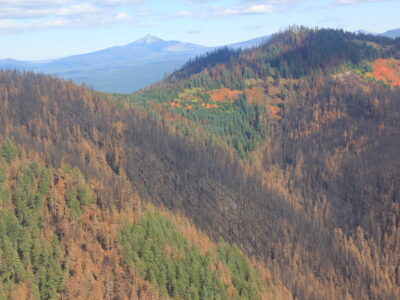
red rock landscape with stream flowing through it

The LTER Network always puts in a strong showing at the Ecological Society of America Annual Meeting and 2026 is no exception. Please use and share our day-by-day list of LTER and related events to find your footing at this fun and approachable meeting. If you don’t see your talk or session listed below, please… Read more »

2026 Site Exchanges Announced

LTER colors with graphic of multimple location markers overlayed.

Site exchanges are designed to facilitate between-site comparisons and support the development of cross-site projects. The 2026 awardees exemplify a variety of approaches to such collaboration, including: shared sampling efforts, development and dissemination of new methods, collaboration on shared best practices, and work toward joint publications.

Shirah Strock | Virginia Coast Reserve LTER to Santa Barbara Coastal LTER

Smiling woman with long brown hair

Doctoral student Shirah Strock will travel from the Virginia Coast Reserve (VCR) LTER to the Santa Barbara Coastal (SBC) LTER. She will receive hands-on training in ViQi, an AI platform used to quantify sessile organism (algae, invertebrate) recruitment from long-term benthic imagery.

Vivian (Lin) Hou | California Current LTER to Northeast Shelf LTER

Headshot of Vivian Hou

Lin Hou, A PhD student at the California Current (CCE) LTER site, will visit the Northeast Shelf (NES) LTER to refine her Imaging Flow Cytobot (IFCB) analysis techniques, drawing on approaches used in the Sosik lab at Woods Hole Oceanographic Institution.

Dr. Nicholas Medina | Morton Arboretum to Minneapolis-St. Paul LTER

headshot of Dr. Nicholas Medina

Dr. Nicholas Medina will travel to the Minneapolis-St. Paul (MSP) LTER and sample soils for eDNA extraction and ITS sequencing. The results will complement MSP data on tree distribution, soil nutrients, heavy metals, and earthworms, while expanding Nicholas’ work on the temporal dynamics of mycorrhizal fungal exploration traits.

Brittany Washington | Baltimore Ecosystem Study to Two Urban LTERs

Brittany Washington, a PhD student with the Baltimore Ecosystem Study, will visit the two LTER urban sites: Central Arizona-Phoenix (CAP) LTER and Minneapolis-St. Paul (MSP) LTER to become familiar with groundwater connectivity and how it is assessed at these two very different LTER sites.

Melissa Frost | Kellogg LTER to Konza LTER

headshot of a smiling woman with shoulder-length strawberry-blond hair over an image of prairie grasses in the sunrise

Melissa plans to visit the Konza Prairie (KNZ) LTER to observe a field trip in action and get inspiration for what could be possible in the KBS partnership network and schoolyard research. She is planning long-term data collection at a distributed network of schoolyards and would like to base her approach on that taken by KNZ Education Manager Jill Haukos.

Cameron Clay | Minneapolis-St. Paul LTER to Luquillo LTER

Cameron Clay, leaning against a tree

Cameron Clay will visit Luquillo (LUQ) LTER to learn how to install, process, and analyze minirhizotron monitoring systems working with Dr. Tana Wood and Laura C. Rubio Lebrón. At MSP, Cameron will deploy a minirhizotron system into an existing floodplain forest experiment. The skills he gains in Puerto Rico will allow for the creation of parallel projects at these two LTER sites to test how extreme fluctuations in soil moisture affect root traits.

Grace Cawley | California Current LTER to Northeast Shelf LTER

Smiling woman in front of a bluff overlooking the ocean.

Grace Cawley will travel from the California Current Ecosystem (CCE) LTER to the Northeast Shelf (NES) LTER to conduct field and laboratory work with scientists at Woods Hole Oceanographic Institution. She will draw on protocols developed within the California Current Ecosystem LTER to explore how NES zooplankton sampling can be extended to support size-resolved and image-based analyses.

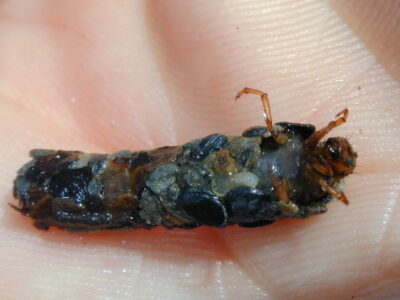
The caddisfly stole my heart

Caroline McCoy’s two-years as an ARETS Fellow impacted and expanded her approach to teaching science profoundly. I was inspired to learn more and it was the caddisfly that stole my heart. The caddisfly would end up becoming front and center in the lesson plan I would be writing.